Wednesday, November 18, 2009

David Spriggs

Now that I have completed my work it seems there are a million artists out there working in a similar way with layers of transparency to create three dimensional photographic works.
Here's a guy that knows what he's doing!


"An exploration into concepts of space and the relationships between the thresholds of the 2 and 3 dimensions; the immaterial form; perception; deconstruction; time; movement including speed and stasis; phenomena; the body; the appropriation of symbols; and the strategies of power.

With influences from Futurism and Cubism to current digital media art and cinema, these hybrids of two and three dimensions bring together painting, drawing, photography, digital media, and sculpture, to create a spatial image system.

Topographical cross-sections of a subject are painted or drawn onto sheets of transparent film. The sheets are specifically spaced and hung apart to reveal the appearance of three-dimensional forms in a state of suspension.

Like linear perspective is to the 2D world; layered perspective allows the possibility of new representations through this illusionary image space. The multiple image planes together establish a perspective in which the viewer can alter their viewing angle to change the 'image form' as one walks around the piece. It is a dematerialization of the picture plane through the combining of multiple picture planes." from David Spriggs Artwork Archive

Monday, October 12, 2009

Xia Xiaowan - 3D Artworks


Xia Xiaowan moves beyond the traditional boundaries of painting and establishes a new way of looking by giving two dimensional painting a three-dimensional effect. The audience is encouraged to view the artwork from different perspectives, moving around it. His work intergrates sculpture, painting. photography and a kind of x-ray medical technology.


In terms of my own work, it is good to discover an artist using transparent layering as a way to push the boundaries of 3D still imagery. The way he uses heavy glass panels is also interesting and something I am considering.

PhotoSketch - Internet Image Montage


A program created by students in China and Singapore, PhotoSketch allows you to create photomontages from simple line drawings. Using internet image data, it selects the best fit images which match your scribble to compose your final photograph.
This is truely something - it further questions our understanding of truth in a photograph as well as highlighting authorship and copyright issues.

Sketch2Photo: Internet Image Montage from Tao Chen on Vimeo.

more on CR Blog

Monday, September 14, 2009

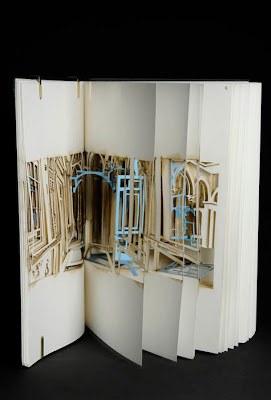
Johan Hybschmann 'Book of Space'


This is truly unbelievable and I imagine these photos do not do it enough justice… The pages of Hybschmann's book are precisely laser cut, then as the book is opened and the pages are turned, these cuts work together to form a spatial representation of the single, highly choreographed 90-minute shot that is Alexander Sokurov's film Russian Ark. (watch trailer here)

“ The inspiration came directly from the single shot film sequence in Sokurov’s Russian Ark, where the camera is taken through the timeless spaces of the Winter Palace, jumping decades from one room to another. The distortion of time is, of course, interesting in terms of the timelessness of the spaces – but I was interested in the way that the camera never looks back. Even though the viewer never sees the full dimensions of these spaces, we are still left with a sense of coherence and wholeness. But what if the back of the room was mindblowingly different? It’s as if we constantly use the previous space to create an understanding of what should be behind us.
You pick up a book, and you open the covers... and a series of rooms begins to pass by, like the frames of a film or sequences in a flipbook, and it's all due to laser-cut gaps and remainders. How amazing to think that we could slice entire works of architecture into all the books around us, so that "reading" a book would actually be a forward-moving optical journey through page-sized rooms and hallways” - Johan Hybschmann (from BLDGBLOG)

Wednesday, August 26, 2009

Anthony McCall 'Line Describing a Cone'

Another clever use of mist.
McCall's
1973 work 'Line Describing a Cone' was pivotal in terms of defining structural film and the viewer's interaction.


Anthony McCall Line Describing a Cone 1973
Installation view at the Musée de Rochechouart, 2007
Solid light installation, 30 minutes
16 mm film projector, haze machine

Tuesday, August 25, 2009

Alternative video projection ideas

I'm exploring the idea of projection of a moving image onto mist, dust or fog, drawing attention to the illusion of cinema. This in turn would help create a space which viewers can navigate through and around, making the whole viewing process more of an experience.

Here are a couple of artworks I discovered which deal with projection onto impermanent surfaces:


Carsten Nicolai 'Fades' (2006) Installation in lightproof auditorium, video projection (16:9 ratio), mist, sound
the projected light hitting the mist particles create a light sculpture in three dimensional space.


Primal Source (video documentation) from haque d+r on Vimeo.
Primal Source (2008) is an outdoor interactive/performance installation. The piece is projected onto a large water/mist screen and responds to the sound waves produced by the audience.


The Liverpool Culture Company 'City of Light' (2005) video projection onto water
This also utilizes the large outdoor water screen and coloured laser lights, creating a 30 minture video.

Monday, August 24, 2009

Bjork 'Wanderlust' in 3D


Video for Bjork's 'Wanderlust' available in 3D on Wired.
Even quite beautiful without the aid of 3D anagylph glasses.

Thursday, August 20, 2009

Daguerreotype Stereoportrait

A visit to the Otago Settlers Museum introduced me to the world of stereography as it existed long before the plastic viewmaster.
The Daguerreotype stereoportraits were often placed in special viewing kits, with lens that you could fold out and look through.


The most beautiful were the 'french tissue' ones, which were hand coloured and had little holes pierced into places on the subjects' clothes, so when held up to the light it appeared as though the image had jewel-like embellishments.

This is the viewer we used to look at various the images:


photo by Max Oettli Stereoscopic viewer and stereo Cyanotype

Monday, August 10, 2009

Siggraph - Touchable Holography

Presented at the 2009 Siggraph Emerging Technologies conference, this is just the beginning of something pretty revolutionary in the way we understand 3D imaging.


"Researchers at the University of Tokyo are working to create holographic displays that mimic the sensation of interacting with solid objects....researchers place a reflective marker on a person's hand and use Nintendo Wiimotes to track the position of the hand relative to the hologram. As the hand gets near the hologram, the display triggers a feedback mechanism, which feeds acoustic radiation pressure to the hand, creating the sensation that the person is touching an object. At the same time, the hologram reacts to the hand's position, and can be batted, grabbed, or floated based on the hand's position.
" -from I09

Monday, August 3, 2009

Got my milk, got my cookies, got my Viewmaster

Ever since I was little I was fascinated by the 'real' appearance of images inside of a Viewmaster.
Somehow those little discs could make everthing jump out, like you were actually in the image.

Stereoscopy (the technology utilized by the Viewmaster) is any technique capable of recording three-dimensional visual information or creating the an illusion of depth in an image.
The illusion of a 3D image is made possible by the viewmaster device which allows each eye to see a different image, distorting our binocular vision.

Under the umbrella of Stereoscopic imagery there's a bunch of things I find exciting. While the Viewmaster works in a Spacial or Cross-converged way, there's also complementary colour Anaglyphs (which you use those retro-looking red/blue glasses for) and Autostereograms (magic-eye type illusions), Lenticular printing and Holography.

While it is possible to create 3D stereoscopic images, we still seem to rely on a viewer to see the illusion. You can create your own 3D film (though this still requires 3D glasses), or you can spend ages squinting your eyes at pictures of cats on YouTube, like I did.
I'm just beginning to understand this and get my head around it, but definitely something to go on and explore within my work.


Want to see a guy inside a giant viewmaster? YES PLEASE.


Xavier Chassaing 'Scintillation'

Xavier Chassaing creates a film from over 35,000 photographs and a combination of live projection mapping techniques.
The use of single frames to describe movement is almost seemless here, and what I first notice is the extremely short depth of field which moves along a single close-up object, changing the focal point in a very photographic way.

SCINTILLATION from Xavier Chassaing on Vimeo.


How is it done?

“Scintillation” is an extraordinary and beautiful example of what can happen when an artist stows away in his apartment for eight months with nothing but his computer, a digital video projector, a DSLR and his imagination. French director Xavier Chassaing mounted his still camera on a homemade motion control rig capturing images as it moved 1mm per second. With multiple passes at varying exposures, the final piece uses 35,000 digital images. Chassaing then rendered 3D particle systems onto 3D models of the real life objects that would later act as a canvas for the projected visuals. Chassaing adds, “The shooting is 30 times slower than reality, resulting in having to gather as much material as for a feature film.”
from Stash Magazine online

Röyksopp 'The Girl And The Robot'

A few frames from the opening scene of The Girl and the Robot music video, I just love the lighting so much here!


Monday, July 27, 2009

motion//picture//cature

Link to my theory essay 2009 here.

Tuesday, July 14, 2009

Tuesday, June 23, 2009

Rosemarie Fiore 'Bonus Round Exposure'

Caputuring the whole duration of gameplay. One of those 'I wish I had thought of it first' ideas.

"These photographs are long exposures taken while playing video war games of the 80's created by Atari, Centuri and Taito. The photographs were shot from video game screens while I played the games. By recording each second of an entire game on one frame of film, I captured complex patterns not normally seen by the eye." -Rosemaire Fiore


"Tempest 1" 2001 digital c print 4 ft x 6 ft


"Quantum 2' 2002 digital c print 36 in x 40 in


"Gyruss 1" 2001 digital Lamda print 30 in X 30 in

Wednesday, June 10, 2009

Marco Brambilla 'Civilization'

I can't say too much except OH MY GOD THIS IS SO COOL. The fact that the piece is installed in a elevator works simultaneously with the ascending imagery too. I wonder if you could call this video montage? Like cut and paste video segments.
The embedded version is just from YouTube, but you can view it on Motionographer and check out the write up behind the work too.

Saturday, June 6, 2009

Polar Panoramics


Been having a bit of a look at polar panorama photography and video.

2.5D - Polar Panoramic Video from Valentijn Kint on Vimeo.

Friday, June 5, 2009

Keith Loutit 'Bathtub IV'

Tilt-shift miniature videos! ..who knew..
Keith Loutit combines the miniature faking with time lapse in his little videos.

Bathtub IV from Keith Loutit on Vimeo.

Microsoft // Photosynth

Taking photographs of the same scene or object then automatically stitched together into one big 3D interactive piece. It's kind of a visual mixing tool which moves us through a space and time... and can essentially trasform the way we view and experience still images.

Slinkachu 'Little People' A Tiny Street Art Project

For more images check out Slinkachu blog


'Wonderland' Battersea Park, London


'Vandalized Cash Machine'
'They're not pets,Susan' Primrose Hill, London